
By the PipeElectric team · Published October 30, 2026 · Updated October 30, 2026
Sewer line replacement cost in Texas is usually priced by the foot, and national guides put it at about $50 to $250 per linear foot. This Old House's March 2026 data shows a total range of $1,390 to $5,320, averaging $3,320. Neither guide breaks out Texas, so these are national market figures, and they are not PipeElectric prices.
What does sewer line replacement cost per foot?
Per-foot pricing is the fairest way to read a sewer quote, because length drives so much of it. National market figures look like this:
| Method or location | Market cost per linear foot | Source and date |
|---|---|---|
| Traditional excavation | $50-$200 | This Old House, March 2026 |
| Trenchless, overall | $60-$250 | This Old House, March 2026 |
| Pipe bursting | $60-$200 | Bob Vila, January 2023 |
| Cured-in-place lining | $80-$250 | Bob Vila, January 2023 |
| Line under a concrete slab | $300-$350 | Bob Vila, January 2023 |
The 2023 figures are older, so expect some drift upward. Neither guide gives Texas numbers, and local labor and access can move them.
Got a sewer quote you can't read? Call and go through it.
- ★ 5.0 on Google, 18 reviews
- Sun–Thu 7 AM–8 PM · Fri 7 AM–6 PM · Sat closed
- Clear, upfront quote
How does length change the total?
Multiply the run by the rate, then add access work. This table is plain arithmetic using the $50-$250 market range, and it is no estimate for your property:
| Line length | At $50 per foot | At $250 per foot |
|---|---|---|
| 30 feet | $1,500 | $7,500 |
| 60 feet | $3,000 | $15,000 |
| 100 feet | $5,000 | $25,000 |
Totals from guides run lower than the top of this table because many jobs are short sections, and fewer jobs hit the highest rate across the full run. A repair to one section should never be priced like a full replacement. A sewer line repair on one failed joint is a much smaller job.
Why can two Texas houses get very different quotes?
What sits on top of the line moves the price more than any state border does. Check these before you compare numbers:
- Slab: a line under the foundation means tunneling or cutting concrete
- Depth: a deeper trench takes more time and may need shoring
- Hardscape: Bob Vila listed driveway repair at about $1,750 in 2023
- Landscaping: the same guide listed cleanup at $100 to $350
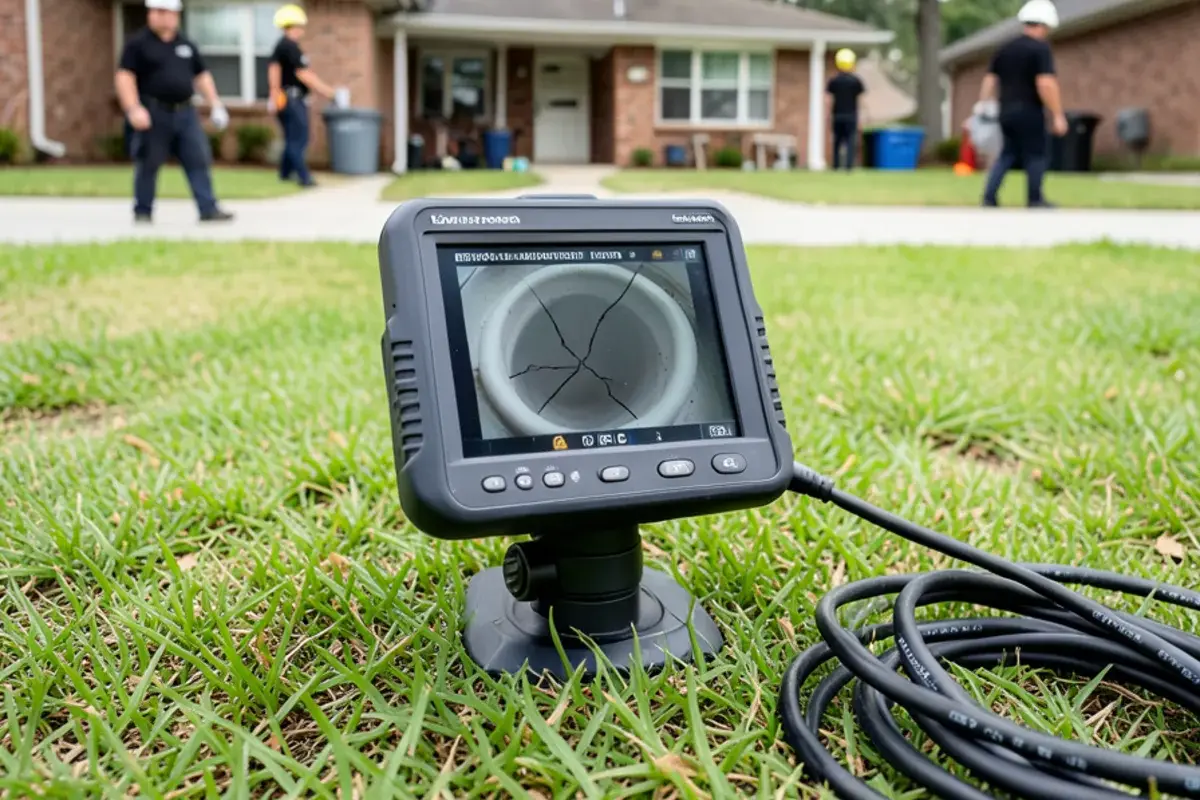
- Camera inspection: listed at $100 to $500
- Permit: listed at around $200, depending on the city
- Cause: roots or a collapse can change the scope
Ground conditions count too. Houston's soil is clay, and movement can pull joints apart. Areas near the Houston Ship Channel had sunk by up to 7 feet by the 1970s, according to Wikipedia's geography of Houston entry. In a neighborhood such as Galena Park, that history is a good reason to check the grade of an older line rather than only its condition.
Newer add-on figures
This Old House's March 2026 guide gives fresher numbers for many of the same line items. They are national market figures, so use them to sanity-check a quote:
| Line item | National market figure |
|---|---|
| Camera inspection | $100-$500 |
| Permits | $100-$1,000 |
| Concrete repair | $1-$20 per square foot |
| Landscaping | $4.50-$12 per square foot |
| Yard leveling | $1-$2 per square foot |
| Tree root removal | $80-$1,000 |
The permit range is wide because fees and rules are set locally, so ask the city or utility district that serves your address. In Houston, the Permitting Center says the city follows the 2021 Uniform Plumbing Code with local amendments, effective January 1, 2024.
Should you dig, line or burst the pipe?
The method depends on the pipe's shape, route and what is above it.
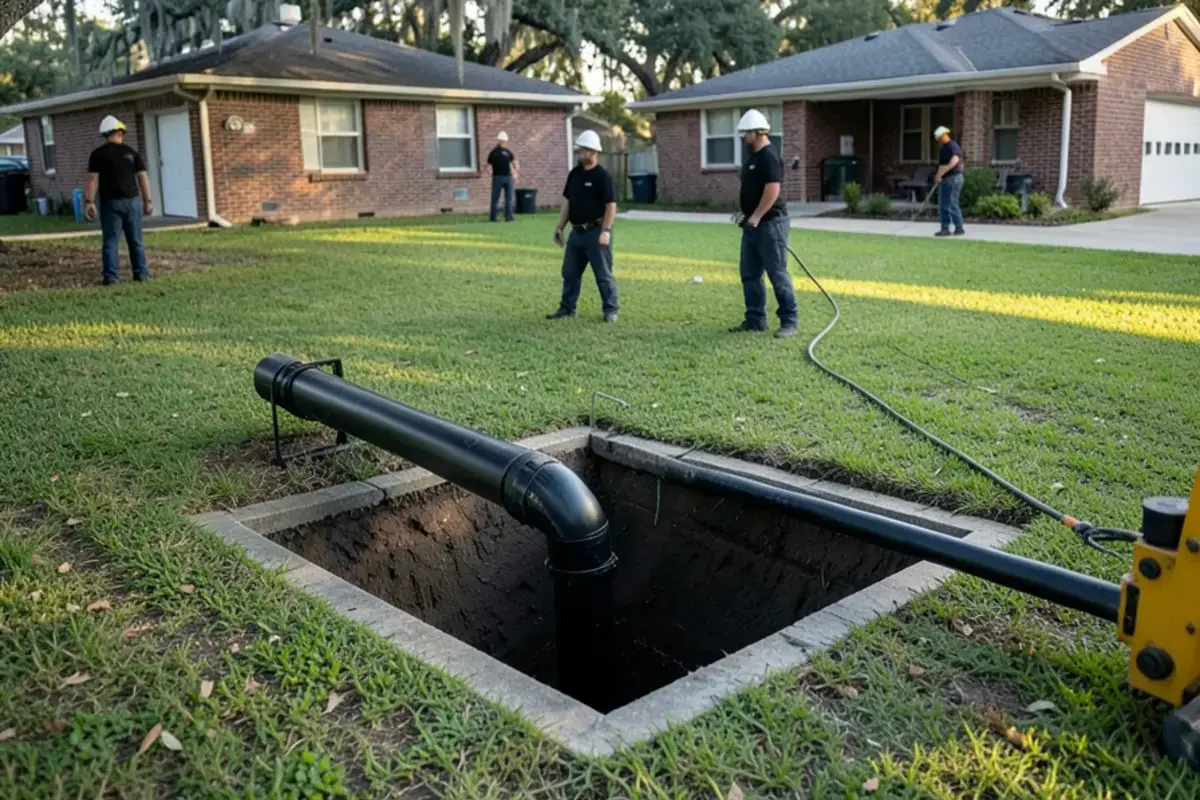
- Excavation removes the old pipe and lets the plumber reset the grade. It disturbs the most ground.
- Pipe bursting pulls an expander head through the old line while new pipe, commonly HDPE, follows. It needs launching and receiving pits, so it is not fully dig-free.
- Cured-in-place lining forms a new pipe inside the old one with a resin-soaked tube. Once lined, the pipe cannot be cleared with cables or snakes and typically needs high-pressure jetting.
A liner follows the pipe it sits in. If a line has sagged, lining keeps the sag. That is why a sewer line replacement after soil shift often starts with digging and regrading.
Which pipe should go back in the ground?
Plastic is the usual choice for a new lateral, because it has a smooth wall and few joints for roots to find. This Old House's March 2026 guide gives these life spans, and the fit column is general trade practice:
| Material | Listed life span | Where it fits |
|---|---|---|
| PVC | 100+ years | Most open-trench replacements |
| Cast iron | 75-100 years with proper care | Tying into an existing iron system |
| HDPE | Not listed | Pipe bursting, where a fused line is pulled through |
The pipe matters less than how it is laid. Plumbing codes generally call for about 1/4 inch of fall per foot on a house drain. In Gulf Coast clay, the bed under the pipe counts too, because a line set on loose backfill can settle into a new belly. Ask how the trench will be bedded and compacted, and get that in the scope.
Who pays for which part of the line?
In most Texas cities, the homeowner pays for the private lateral and the utility pays for the public main. Where one ends and the other begins changes by city, so call before the job is scoped. A quote that runs past the handoff point may be billing you for pipe that belongs to the utility.
Some Texas cities have run help programs for private laterals, often tied to income. Terms change, so ask your utility what exists today.
What does a partial repair cost by comparison?
A repair can cost far less than a new line when the damage is local. Bob Vila's January 2023 guide listed root removal at about $100 to $600 and a cracked pipe at about $1,050 on average. It listed collapsed line work at $50 to $250 per foot. Those are dated national figures, so use them to compare scale, and do not treat them as a price.
Ask whether the failed section is one spot or a pattern. A single offset joint in sound pipe is a repair. Several failed joints in an old clay or fiber line often make a replacement the cheaper choice over time.
Our team's advice before you approve a sewer replacement
See the problem yourself before you sign. Our team's general advice comes down to five checks:
- Ask for a sewer camera inspection with the footage, and watch it with the plumber.
- Ask how many feet are failing, and where.
- Get the method, pipe material and length in writing.
- Check who restores the driveway, lawn or floor.
- Ask who handles the permit, and check the city's rules with its permit office.
Get more than one written estimate on a big job. Compare the footage, the length and the method along with the price.
What should you take from these numbers?
Use the market figures to judge whether a quote is in a believable range, and use the camera to judge whether it is the right job. A short section in open soil and a long run under a slab are different projects, even on the same street.
PipeElectric looks at the line first, then gives a clear, upfront quote. Until then, the only honest answer is a range.
Common questions
How do I know the sewer line needs replacing and not just cleaning?
Look at the camera footage. Roots or grease in a round, intact pipe can usually be cleaned or repaired. Breaks, collapsed sections, heavy offset joints or standing water along a long stretch point to replacement. Ask the plumber to show you the footage at each problem spot and to mark the distance from the cleanout.
Is a sewer line replacement cheaper with trenchless methods?
Not always per foot. This Old House lists trenchless work at $60 to $250 a linear foot against $50 to $200 for excavation, as of March 2026. The savings come from less landscaping and restoration. If the line runs under a driveway or mature trees, that can outweigh a higher per-foot rate.
Does homeowners insurance pay to replace a sewer line?
Usually not for ordinary wear, roots or age, though policies differ. Some insurers sell a separate service line endorsement. Read your policy or ask your agent before the work starts, and keep the camera footage, since an adjuster may want to see the cause of the failure.
Who pays to replace a sewer line between the house and the street in Texas?
Usually the homeowner pays for the private lateral, and the utility pays for the public main, though the point where one ends changes from city to city. Ask your city or utility district where its side starts before you accept a quote. A few Texas cities offer income-based help with private laterals, so raise that on the same call.
Quoted for a new sewer line? Call and ask what the camera actually showed.
- ★ 5.0 on Google, 18 reviews
- Sun–Thu 7 AM–8 PM · Fri 7 AM–6 PM · Sat closed
- Clear, upfront quote
Written by the PipeElectric team
PipeElectric is a Houston plumbing company with 18 Google reviews and a 5.0 rating. Read about us.