
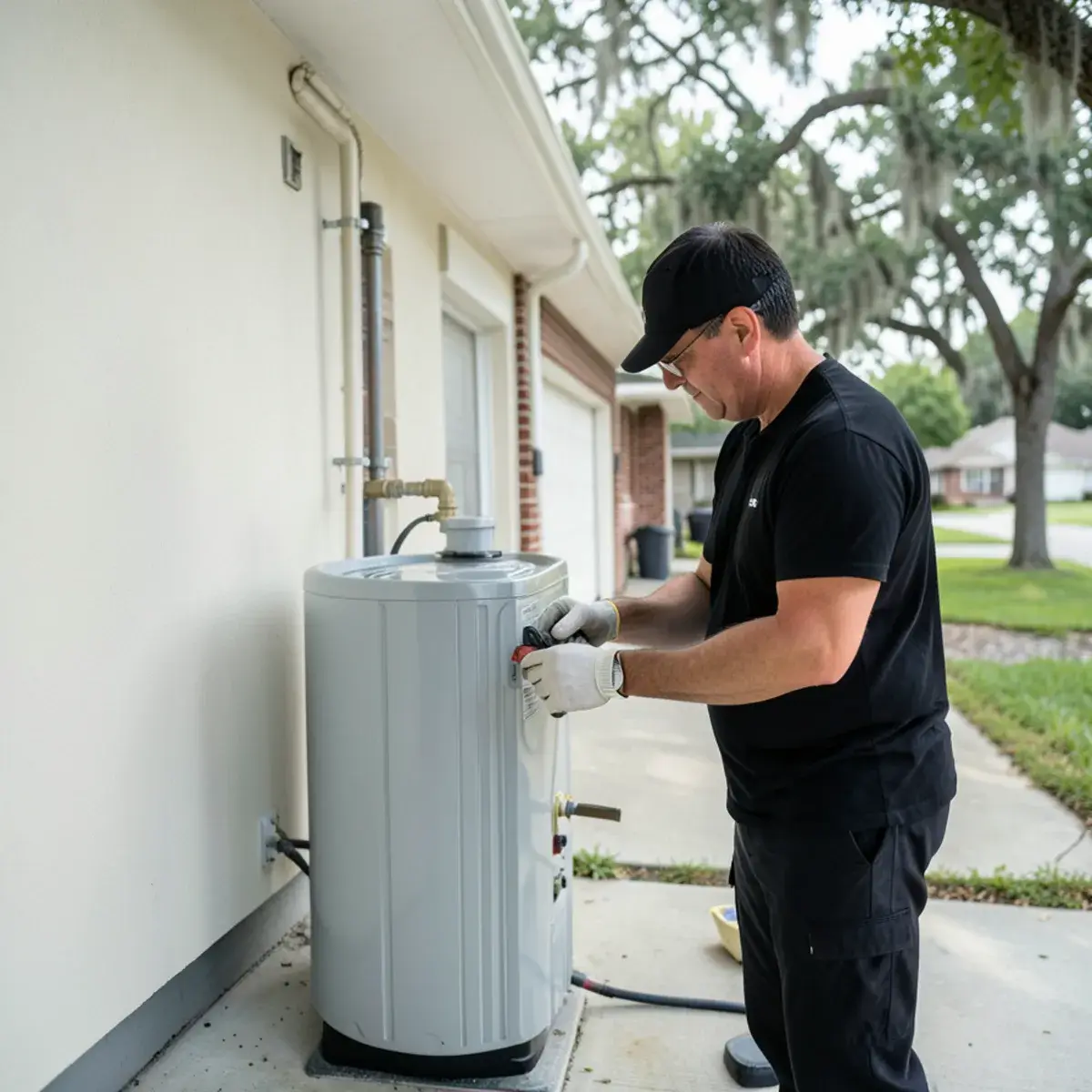
Water softener installation in Houston begins with a number: your water's hardness in grains per gallon. City of Houston water varies by address, so a softener sized for one street can be wrong for another. Measure, multiply by your daily use, then choose capacity. The install itself needs a line, a drain and a power outlet.
Do you need a water softener in Houston?
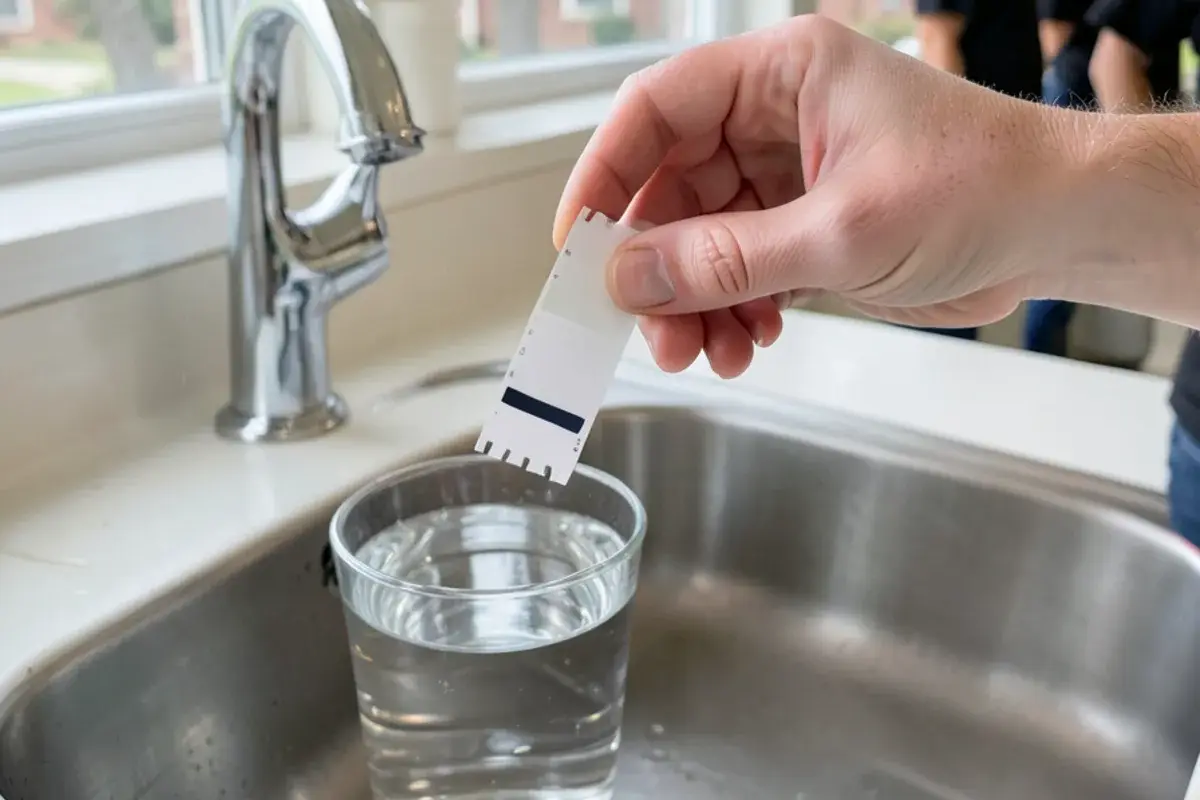
You need one if your tested hardness is high and scale bothers you. Measure first, because the City's water varies by address. USGS calls 61 to 120 ppm moderately hard, 121 to 180 ppm hard, and anything above that very hard. Virginia Tech Extension says water under 7 grains per gallon generally needs no treatment.
A published summary of the City's 2025 report puts the Main System near 7.9 grains per gallon (135.5 ppm), with addresses from 2.5 to 13.4 grains. Some Houston homes sit near that 7-grain line. Others are well over it.
These signs add to the case:
- White scale on faucets, shower heads and kettles
- Spots on glass, and soap that will not lather
- Stiff laundry
- Scale problems in a tankless unit
Read your report on our Houston water quality page, and call if the numbers are hard to follow.
Scale on every faucet? Call and we'll start with your hardness number.
- ★ 5.0 on Google, 18 reviews
- Sun–Thu 7 AM–8 PM · Fri 7 AM–6 PM · Sat closed
- Clear, upfront quote
Is a salt softener your best hard water fix?
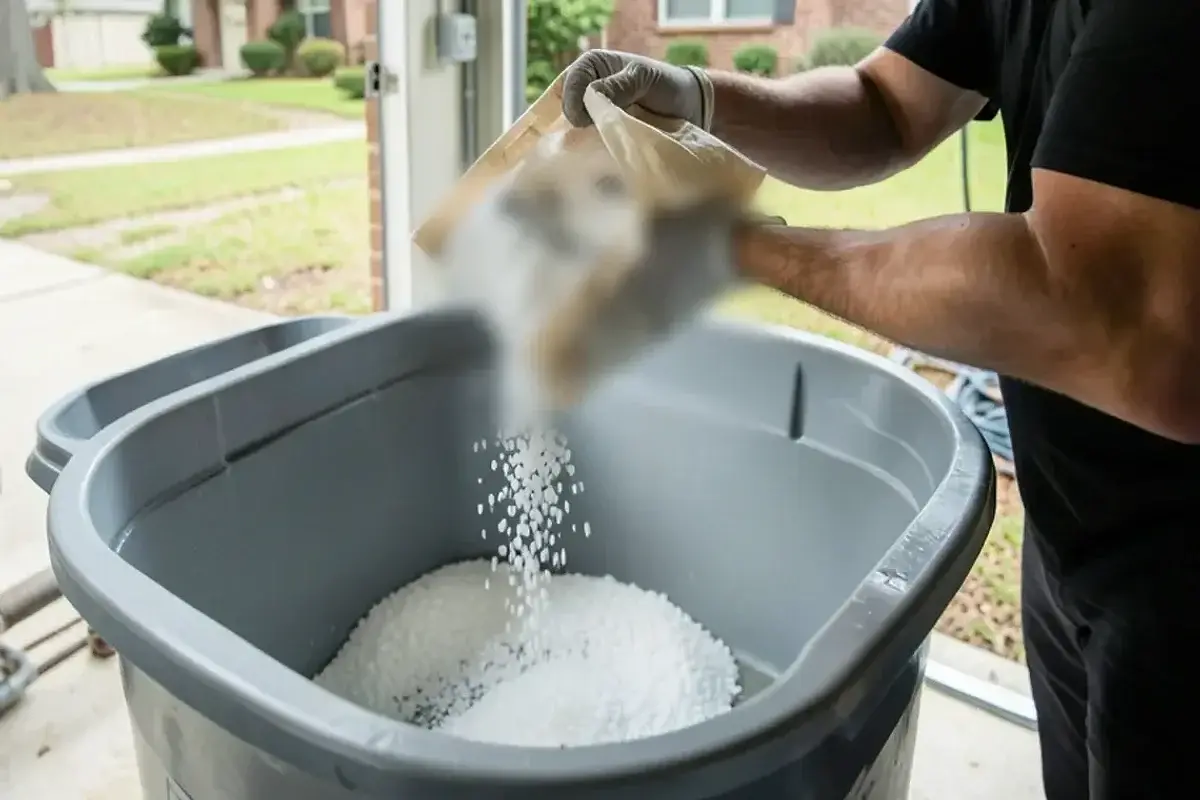
A salt softener is the direct option, because it removes hardness instead of masking it. Resin beads trade their sodium for calcium and magnesium. When the beads are spent, a brine rinse resets them and flushes the minerals to the drain, Penn State Extension explains.
| Option | How it works | Trade-off |
|---|---|---|
| Salt softener (sodium chloride) | Ion exchange | Salt, water use, some sodium added |
| Potassium chloride in the same unit | Ion exchange, no added sodium | Costs more, about 10% more per cycle |
| Salt-free conditioner | Other process | Generally does not lower measured hardness |
| Softener with carbon filter | Softening plus taste control | More equipment, more upkeep |
NSF/ANSI 44 is the standard for household softeners, so check the listing on any unit you compare. For taste and chlorine, a softener alone will not help, and a whole house filter covers that side.
How to size a softener for your hardness and household
Capacity is a simple multiplication. Too small and it regenerates constantly. Too big and the resin sits idle longer than it should.
Here is a worked example using University of Arkansas and Penn State figures:
- People in the house: 4
- Water use: 75 gallons per person, per day, or 300 gallons
- Hardness: 8 grains per gallon
- Daily load: 2,400 grains
- A 24,000-grain softener then runs about 10 days between regenerations
- Salt at half a pound per 1,000 grains: about 36 pounds a month
Each regeneration uses about 50 gallons of water, according to Penn State. That is usually fine on a city sewer, but it may overload a septic drain field, which matters for rural homes south and west of town.
Where does a softener go in a slab home?
It goes on the incoming cold line, ahead of the water heater. Houston homes have no basement to hide it in, so most softeners land in the garage or on an exterior wall. Some newer homes have a softener loop already stubbed out.
The spot needs four things:
- Access to the main line before the water heater
- A drain for the regeneration water, with an air gap
- A power outlet for the valve
- Room to lift salt bags in
Softening helps a tankless water heater stay clear of scale. It can also wear a tank's anode rod faster, so have that checked on schedule.
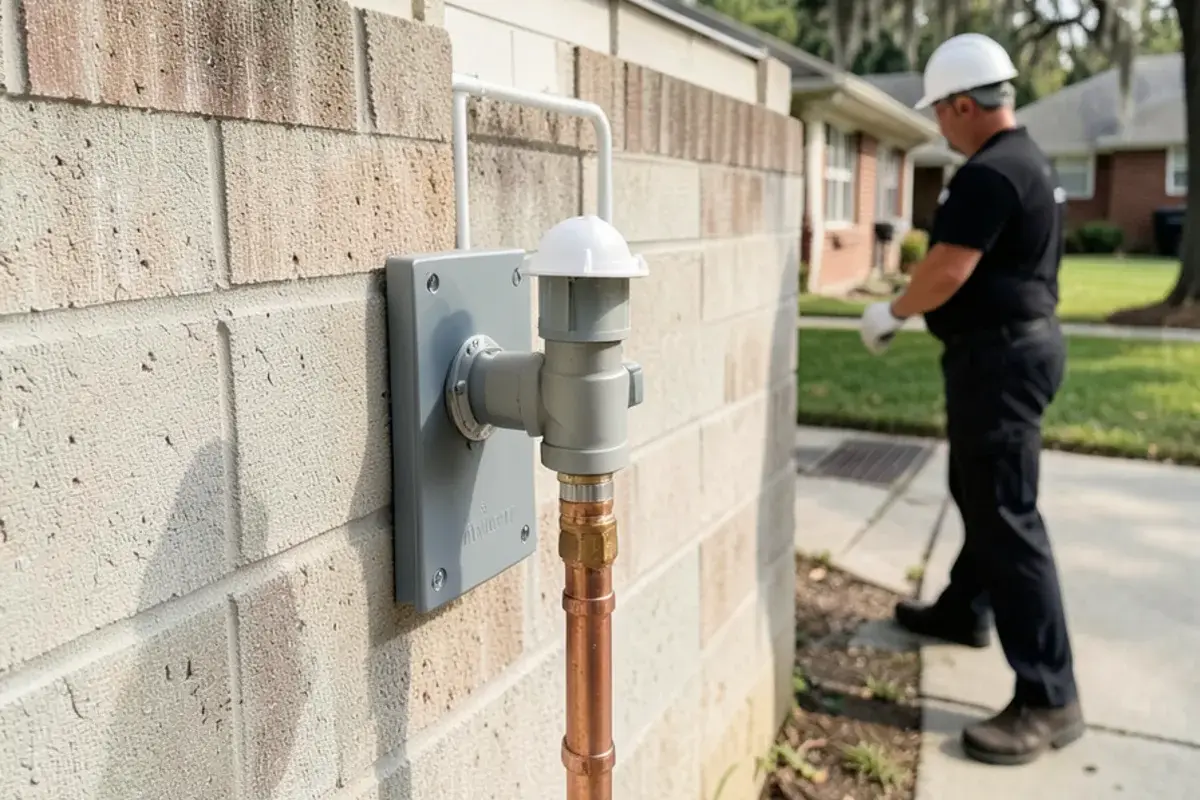
How water softener installation in Houston works
The order matters, so the sizing happens before any pipe gets cut:
- Share your household size, and a hardness result if you have one.
- We test the water and review your utility's report.
- We pick the install spot and confirm the drain and power.
- You approve a clear, upfront quote covering unit and pipe work.
- We shut off the main, tie in the bypass and plumb the softener.
- We run the drain with an air gap, load salt, program your hardness and retest.
What the softener install includes
An install covers the softener and the plumbing around it. Most of the labor goes into the tie-in: a bypass at the main line, a drain for the regeneration water and power for the valve. A ready loop shrinks that work. Without one, the line has to be opened near the main and routed to the unit.
The first setup matters as much as the pipe. A valve set for the wrong hardness wastes salt or lets hard water through, so the setting comes from your test and not from a citywide average.
An iron reading belongs in that same test. NDSU Extension says standard softeners handle up to 10 ppm of iron and manganese, and Penn State Extension warns that iron already oxidized by air or chlorine can clog the resin, so a filter goes ahead of the softener in that case.
What stays unsoftened gets settled here too. NDSU does not recommend softened water for houseplants, lawns or gardens, and on a slab home the location of the hose bibs decides how practical a bypass is.
This work includes:
- A hardness test before and after
- Capacity sizing for your household
- Bypass valve and line connections
- Drain routing and valve setup
- A walkthrough of salt and settings
What affects softener replacement and install cost?
Plumbing access matters as much as the softener itself. We quote your job after a look. These factors move the number:
- Capacity: grain rating for your hardness and water use
- Valve type: demand-controlled or timed
- Loop: a ready loop, or new line to the main
- Drain and power: a nearby standpipe, or a longer run
- Old unit: removal of an existing softener
- Add-ons: a carbon pre-filter, or a kitchen bypass
Running costs belong in the comparison too. In the worked example above, four people at 8 grains go through about 36 pounds of salt a month, and each regeneration sends about 50 gallons to the drain. Ask how each quoted valve decides when to regenerate, because that drives both numbers for years. Penn State says timed models suit steady water use and waste salt when they regenerate without need, while demand-control models suit households whose use changes.
Salt choice adds to the running cost. Potassium chloride costs more per bag, and salt purity affects how often the brine tank needs cleaning, according to NDSU. Its guidance also says a higher price does not always mean better performance, so compare grain capacity and valve type before you look at the sticker.
Softener licensing and permits in Texas
Texas treats softeners differently from water heaters. Occupations Code Section 1301.053 does not require a plumbing license for water treatment installations, though the work stays subject to inspection under state law or city ordinance. TCEQ licenses water treatment specialists in Texas under Health and Safety Code chapter 341 and 30 TAC chapter 30, and its guidance points to Texas State Board of Plumbing Examiners licenses as an alternative. Ask any installer which license they hold. Inside Houston, check with the Houston Permitting Center on permit needs for softener work. Suburbs run their own permit offices, so ask the city that bills your water.
Keeping it running: salt, resin and water softener repair
A softener needs little care, but it does need some. Check the salt each month, and keep it above the water line. Update the settings if your household changes. If hard water comes back, look for a salt bridge, an empty tank, or a bypass valve left open before you assume the unit failed. If those check out, the valve or resin may need service.
Why PipeElectric for softener work?
Sizing a softener takes a test and a little math, and a clear explanation goes a long way:
- PipeElectric has 5.0 on Google from 18 reviews.
- Customers mention plain explanations and fair pricing.
- Reviews also mention clean work.
- You get a clear, upfront quote before anything is ordered.
The phones are open Sunday to Thursday until 8 PM and Friday until 6 PM, starting at 7 AM each day. Saturday stays closed. A recent water report or test strip reading makes the first call shorter.
We install and service softeners across Houston and nearby communities, including Sugar Land, Cypress, Friendswood and Missouri City.
What customers say about our plumbing work
5.0 on Google from 18 reviews, checked October 2026.
“The plumbers were very professional and made sure I understood what was going on during the entire process. Their prices are very reasonable as well.”
“They had someone out to my house within a couple of hours. The technician was professional, he explained everything clearly, located the gas leak, and repaired it on the spot. He even double check the rest of the line to make sure there wasn't any other leak. I really appreciated how honest and thorough they were.I highly recommend PipeElectric to anyone looking for fast, affortable and caring service!”
“Had PipeElectric install a new water heater, and they did a fantastic job! Fast, professional, and no mess left behind. Highly recommend them for any plumbing work!”
Water Softener Installation around Houston
- Sugar Land · Greatwood runs 2.0 to 9.6 gpg and River Park 6.4 to 9.1, so sizing depends on neighborhood.
- Cypress · Many Cy-Fair districts converted to surface water, so a softener sized on old well hardness may miss.
- Friendswood · Raised houses along Clear Creek change where a softener can sit, so plan drain and power first.
- Missouri City · MUD supplies here have mixed surface water and groundwater differently by area, so test your own tap.
- Katy · Katy's planned surface water hookup could change hardness, so keep softener settings easy to update.
- Bellaire · The 2024 report shows 52% Houston surface water and 48% Evangeline groundwater, so test the blend.
- Spring Valley Village · About 70% groundwater sets the blend here apart from Houston's, so size from a local test.
- Tomball · City wells draw on the Evangeline and Chicot aquifers, and the report gives no hardness figure.
Water Softener Installation questions
What size water softener do I need in Houston?
Multiply people by 75 gallons a day, then by your hardness in grains. Four people at 8 grains use about 2,400 grains a day, so a 24,000-grain softener runs about 10 days between regenerations. Heavier use or harder water pushes the size up. Go by a real test, not an average.
How much salt does a softener use?
University of Arkansas guidance puts it at about half a pound per 1,000 grains removed. At 2,400 grains a day, that is about 36 pounds a month. Settings and efficiency change the number. A demand-controlled valve regenerates by gallons used, which usually beats a fixed timer in a house with changing use.
Does softened water add sodium?
Yes, a small amount. NDSU Extension says about 8 mg/L of sodium is added for each grain removed. Anyone on a sodium-restricted diet should ask their doctor. A common option is to leave one kitchen cold tap unsoftened, or to use potassium chloride, which costs more and takes about 10% more per cycle.
Do you repair or replace existing softeners?
Yes, both are services here. Water softener repair usually starts with the brine tank, the valve and the settings, because salt bridges and bad timers cause many complaints. If the resin is worn or the unit is badly oversized or undersized, softener replacement may make better sense. We quote after a look.
Are salt-free softeners the same as salt softeners?
No. A salt softener removes calcium and magnesium through ion exchange. Salt-free conditioners use another process and generally do not lower measured hardness. If you want softer-feeling water and fewer spots, ion exchange is the direct route. Ask any seller for a test result and a listing, and read what it claims.
Should outdoor faucets be on softened water?
Usually not. Penn State Extension notes that outdoor faucets and toilets are easy to bypass, and softening lawn water wastes salt. On many Houston slab homes the softener tees into the line after the hose bibs. Where a house was not plumbed that way, a plumber can review what bypass is practical.
How do I maintain a water softener?
Check the salt level monthly, and break up any crust that bridges over the water in the brine tank. Keep the valve settings matched to your hardness and household. Clean the brine tank when sludge builds up. Run the softener through a manual regeneration after a long absence, and watch for hard water returning.
Tired of scale and spots? Call with your hardness number, or ask how to get one.
- ★ 5.0 on Google, 18 reviews
- Sun–Thu 7 AM–8 PM · Fri 7 AM–6 PM · Sat closed
- Clear, upfront quote
PipeElectric - Plumbing & Electrical - HVAC · Houston, TX · (321) 559-0657