
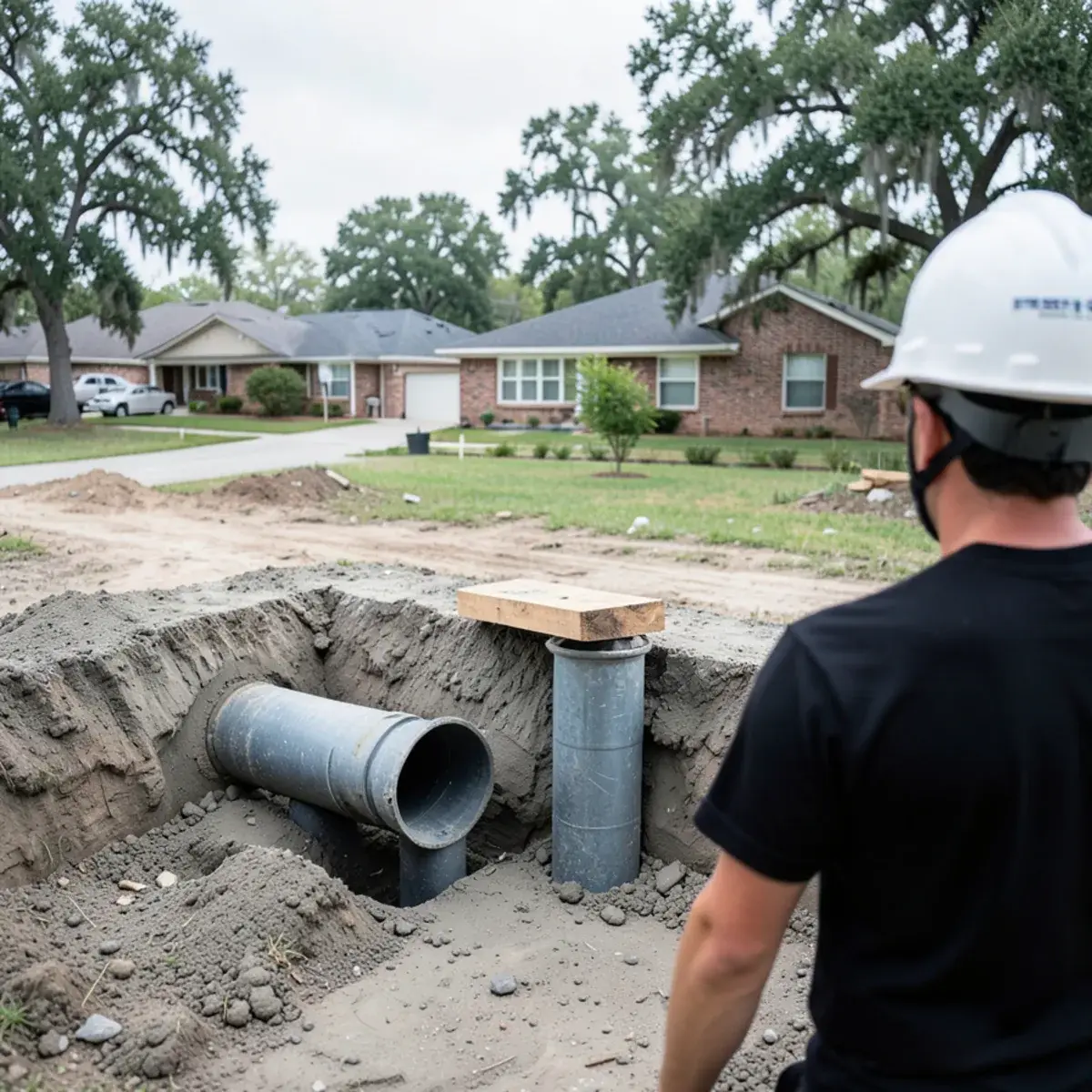
Sewer line replacement after soil shift in Houston is the fix for pipe that clay has pulled apart, dropped or bent. Offset joints and low bellies hold sewage and catch debris, so cleaning only buys time. The job starts with proving what moved, then the failed run is rebuilt with the right slope, under the slab or in the yard.
How does Houston clay break a sewer line?
Clay soil pipe damage starts with a simple cycle: clay swells when wet and shrinks when dry, and pipe buried in it has to move or crack. The USDA describes the Lake Charles soils of southeast Texas as 45 to 60 percent clay, with cracks 1/2 to 2 inches wide that reach 12 inches or deeper and stay open 60 to 90 days in most years. Water pours into those cracks, then the soil seals up and swells.
In July 2022, Houston Public Works said drought can make the soil shift and lead to more pipes bursting. Houston also gets about 53 inches of rain a year by NOAA normals, so a hard dry spell often ends with a fast soak. A sewer feels this badly, because it relies on an even, gentle slope. Water pipes are pressurized, while a sewer drains by gravity alone.
In parts of the metro, the U.S. Geological Survey has also mapped faults that offset the land surface and cause costly damage. If your home sits near one, the ground may be moving for a different reason.
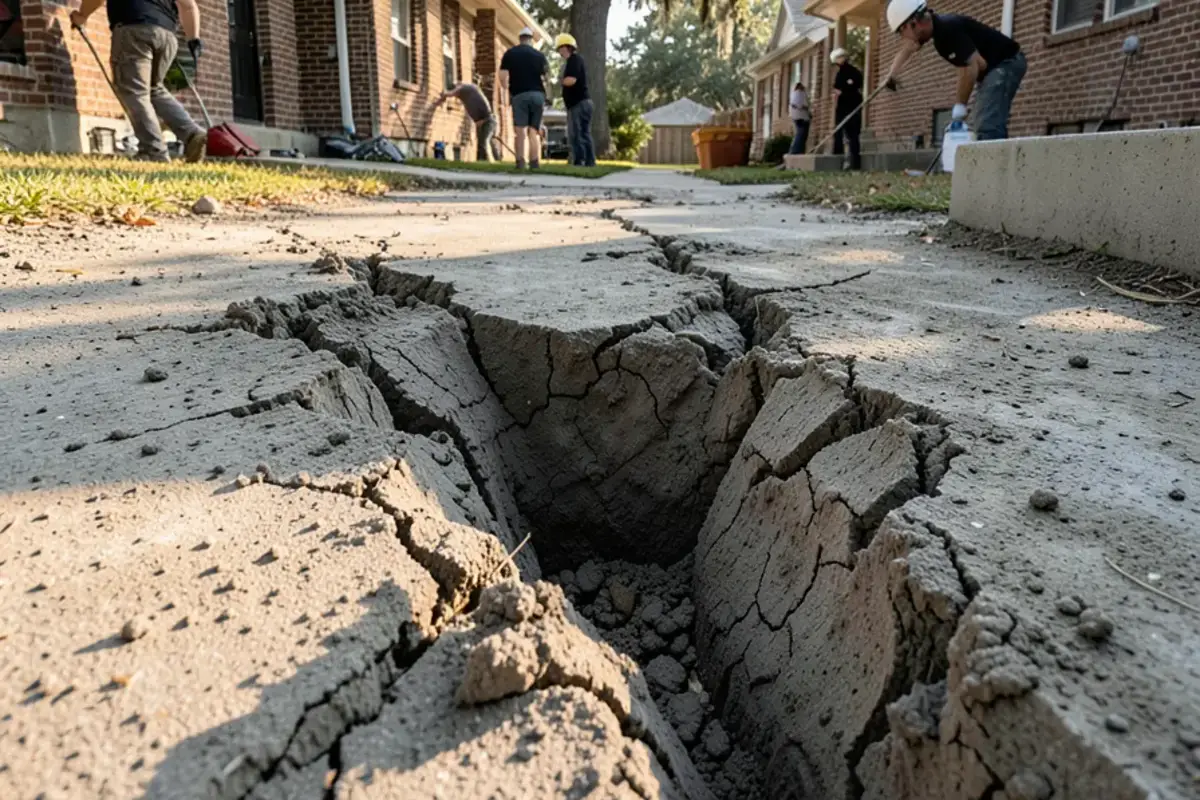
Slow drains and new slab cracks? Find out if the sewer moved with the ground.
- ★ 5.0 on Google, 18 reviews
- Sun–Thu 7 AM–8 PM · Fri 7 AM–6 PM · Sat closed
- Clear, upfront quote
What are the signs of an offset sewer joint or a sewer belly?
Repeat stoppages at the same distance are the classic sign. Look for:
- A cable that catches at the same spot every time
- Drains that slow down after a dry summer or a wet spell
- Stoppages that return soon after cleaning
- A sewage smell near the slab or along the line
- New cracks in floors or walls, along with slow drains
- Doors that started to stick around the same time
- Sunken ground above the path of the pipe
None of those alone proves anything. Slab movement has several causes, so treat them as reasons to look, and not as a diagnosis.
How is soil-shift damage proven?
Three checks separate soil movement from other failures:
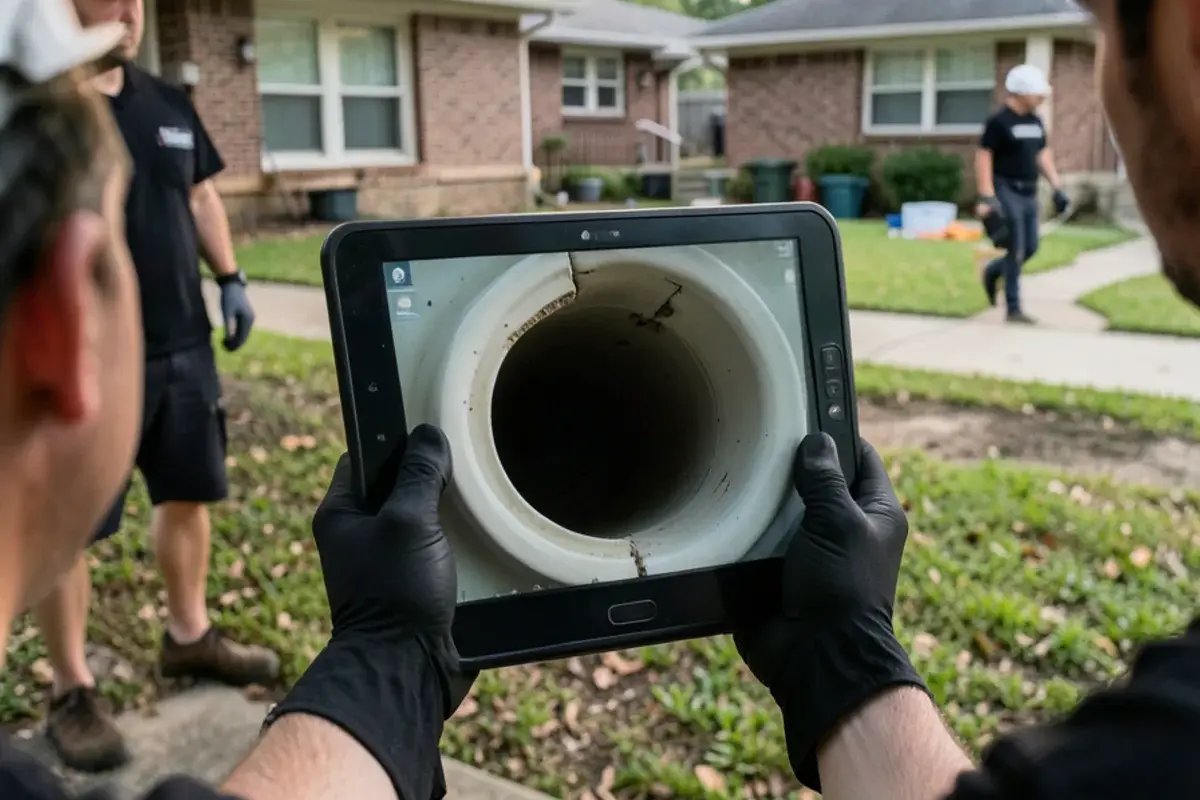
- Camera: a sewer camera inspection shows steps at joints, gaps, and water standing in the pipe. Distance marks place each defect.
- Hydrostatic test: a test ball blocks the line at a cleanout, and the drains under the slab are filled with water. A falling level means a leak somewhere in that system.
- Slope check: standing water on video, or a level on exposed pipe, shows where the line loses its fall.
The Uniform Plumbing Code, which Houston uses in its 2021 edition with local amendments, generally calls for horizontal drain pipe to fall 1/4 inch per foot. A reduced slope needs the local authority's approval. A line that holds water across a long stretch has lost that fall.
If the pressure side of your plumbing is what failed, the job is different. See slab leak repair for supply lines under the foundation.
Repair options: section, reroute or cast iron sewer replacement
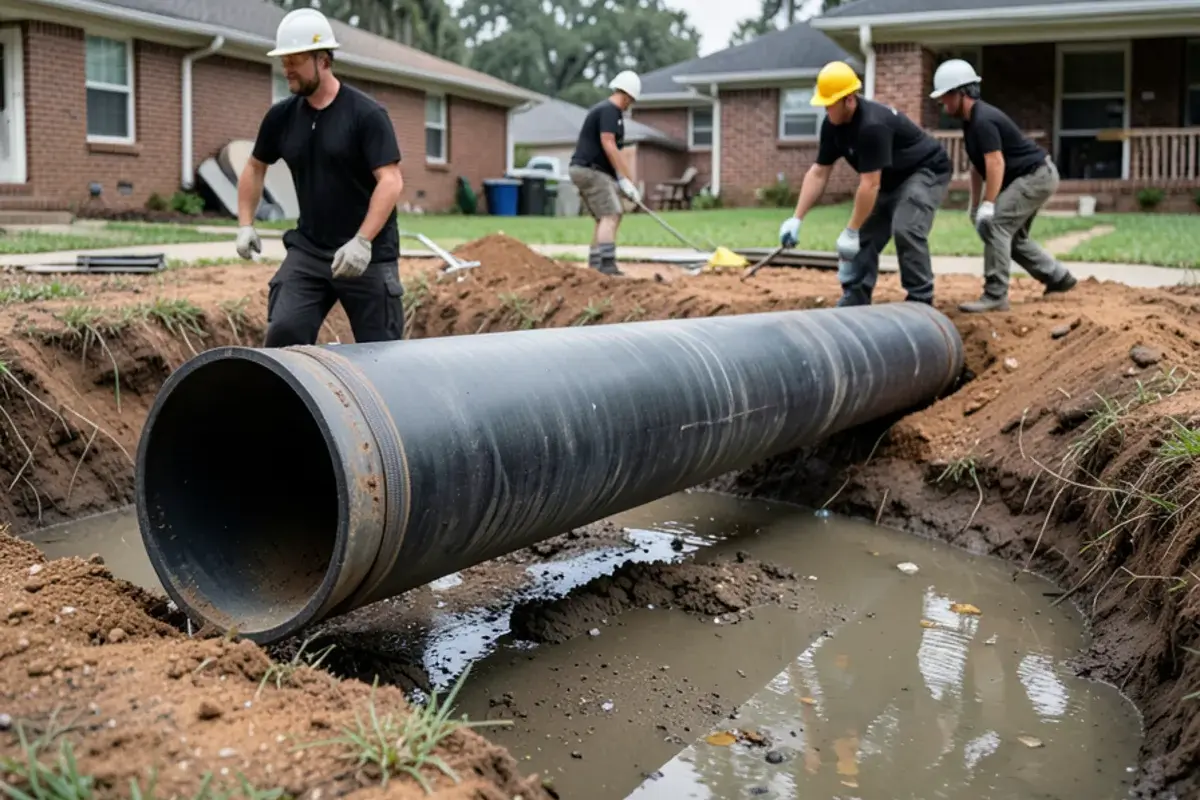
Pick the option that removes the failed run and restores slope. Cleaning will not do that. Several failures along old cast iron usually make the whole run the better job.
| Option | How it works | Best when | Trade-off |
|---|---|---|---|
| Replace one section | Expose the offset, relay that stretch | One bad joint in the yard | Other old joints stay in service |
| Sewer belly repair | Remove the sag, compact support, relay at grade | A defined low run | Some digging, slope must tie in at both ends |
| Tunnel under the slab | Hand-dig to the line, replace from below | Run under finished floors | Slower work and spoil to remove |
| Slab cut | Saw the floor, replace, patch | Room being remodeled | Floor repair, dust control |
| Reroute | Abandon the run, build a new path | Layout allows it | Fixture ties can be complex |
| Full cast iron sewer replacement | Replace the old line, often with PVC | Widespread cracking or scale | Largest job, longest-lived fix |
A liner rarely suits this damage. It follows the shape of the old pipe, so a belly stays a belly.
Which codes govern a soil-shift repair?
Houston's plumbing amendments bar cured-in-place liners on collapsed or compromised pipe, and past City amendments barred trenchless work on cast iron soil pipe. The Houston Permitting Center can say how today's text applies. A City-registered master plumber obtains Houston's sewer connection permit, so confirm whether this repair falls under it. The new run also has to meet the code's fall, and a reduced slope needs the authority's approval. The Texas State Board of Plumbing Examiners regulates the piping, and you should ask any plumber for a license number you can check. Texas law also sets a 48-hour notice through 811 before yard digging.
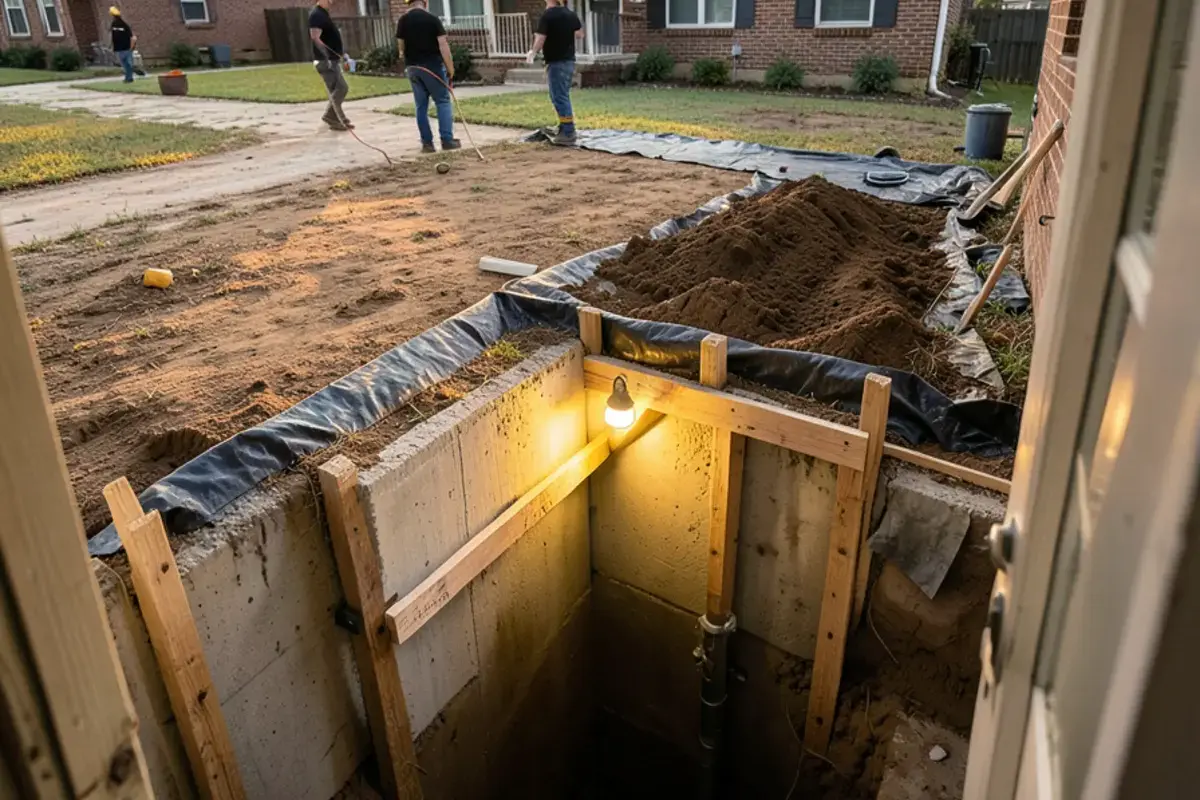
Sewer line replacement after soil shift in Houston: the job in order
Soil-shift repairs involve more planning than a typical sewer job, so expect this sequence:
- Call and tell us about stoppages, slab changes and any foundation work.
- We clear the line, run the camera and mark the defects.
- We test the drains under the slab if the evidence points there, then explain what moved.
- You review your options and a clear, upfront quote before work is scheduled.
- Any permit is confirmed with the City, and utilities are marked.
- We rebuild the run's support, lay new pipe with continuous fall, test it and review it on camera.
What soil-shift work covers
The work covers the failed run and the ground it sits on. Support under the pipe matters as much as the pipe, because a new line on loose fill can settle the same way.
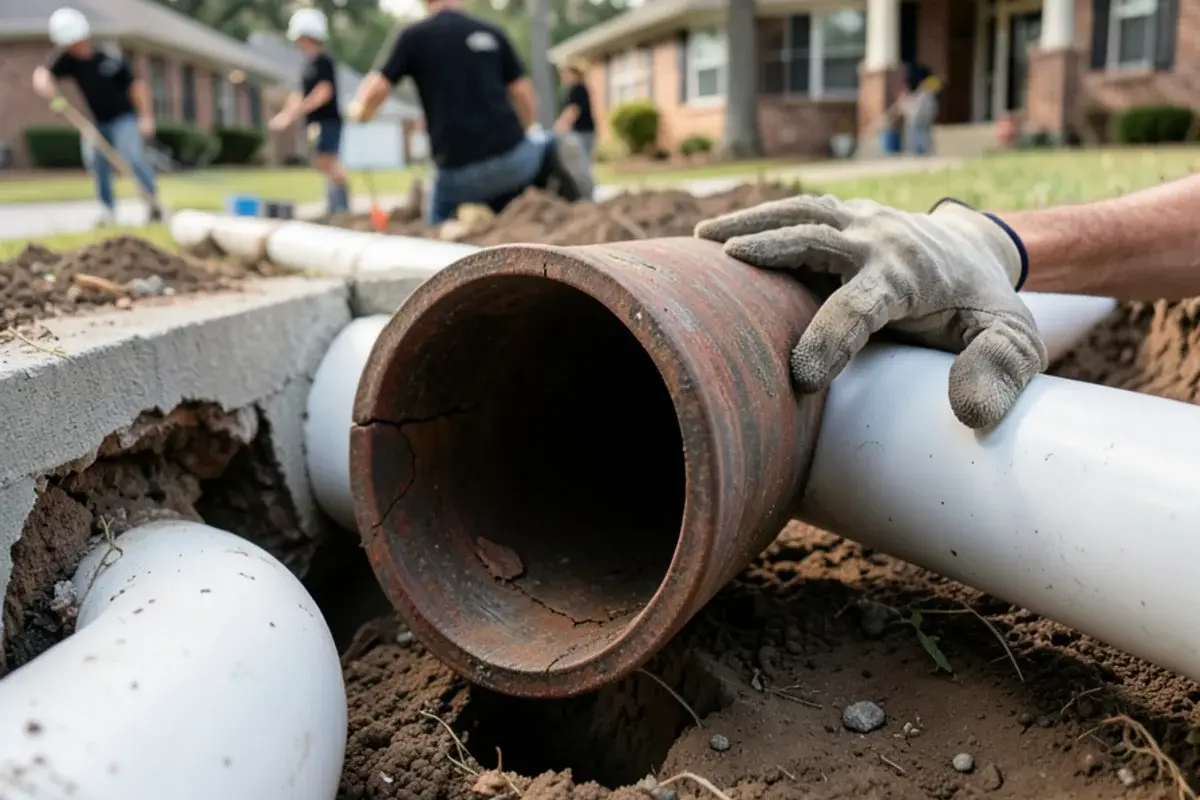
An offset joint usually means cutting out the joint and enough pipe on each side to reach sound, in-line pipe. A belly repair goes further: the low run comes out, the soft ground under it is dug out, and firm bedding goes back before the pipe is relaid. Under a slab, the same work happens in a tunnel or a floor opening, and the spoil has to leave the site. Where new PVC meets old cast iron, the transition coupling has to suit both pipes.
- Camera review and defect marking
- Under-slab drain testing where needed
- Replacement of the agreed run
- Slope check on the new pipe
- A test after the work and a plain summary of the changes
Flooring, slab patching and foundation repair sit outside plumbing work. So does the cause in the ground: no pipe repair stops clay from moving, and a plan for the soil belongs to other trades.
Foundation shift plumbing: what order, and how do you slow the movement?
Get the trades talking before anyone lifts the slab. A leveling job moves whatever sits under the concrete, so ask for a plumbing test before leveling and again after. A structural engineer can tell you whether the slab or the sewer should come first.
You cannot stop clay from moving, but you can reduce the swings:
- Water evenly around the foundation in long dry spells
- Keep gutters and yard drainage sending water away from the slab
- Keep large trees away from the sewer path and the foundation
- Scope the line again after a severe drought or a big foundation repair
What affects the cost of a soil-shift sewer job?
The location of the failed run sets the cost. A yard section is one kind of job, and a run under a kitchen is another. We review the video and the property first, then write up the scope. The main factors:
- Location: yard, driveway or under the slab
- Access: tunnel length or floor area to open
- Length: one joint, or the whole run
- Material: tying new PVC into old cast iron
- Depth and slope: how the new run meets the existing line
- Restoration: floors, slab patching and landscape, usually by others
A tunnel is priced by its length and by how the spoil leaves the site, and a slab cut by the floor area and the finish above it. Testing can add a line, since a hydrostatic test before and after the work may be part of the plan. If several defects sit close together, one longer run may cost less than separate openings. Ask what the quote assumes about restoration, because patching tile and reseeding a lawn are far apart.
Why PipeElectric for soil-shift sewer work?
These jobs depend on evidence and clear choices:
- 5.0 on Google, from 18 reviews.
- Reviews mention plain explanations, which help when the cause is in the ground.
- Reviews mention clean work, and that matters when a job comes through your floor.
- Reviews mention fair pricing, and the quote is clear and upfront.
- Several trades share these jobs, so on-time arrival in reviews counts here.
Phones run Sunday to Thursday, 7 AM to 8 PM, and Friday, 7 AM to 6 PM. Saturday we are closed. Have any engineer's report and past camera video ready when you call.
We take these calls across Houston and in nearby communities such as Missouri City, Richmond, Tomball and Alvin.
What customers say about our plumbing work
5.0 on Google from 18 reviews, checked October 2026.
“PipeElectric did a great job! Had a issue with some outlets and a small leak under my sink. They showed up on time, real professional and got everything fixed quick. Prices was fair too. Definitely calling them again if I need anything else!”
“Had a slow kitchen sink. PipeElectric cleared the clog fast. The plumber was friendly and gave useful tips. Great service!”
“They were quick,professional,and fix my kitchen sink without hassle. Fair pricing and excellent service! Highly recommend”
Sewer Line Replacement After Soil Shift around Houston
- Missouri City · Fort Bend is the Lake Charles clay type location, and 38% of homes date from 1970-89.
- Richmond · Brazos valley soils mix sandy loam and clay under homes from the 1960s and 1970s.
- Tomball · Old Town homes from before 1960 have sat in moving ground far longer than new tracts.
- Alvin · About 52 inches of yearly rain keeps Brazoria clay cycling under 1960s and 1970s lines.
- Spring · A station off Lindell Road shows over 30 cm of sinking since 2007.
- Deer Park · Beaumont Formation clay here cracks a foot deep when dry, under many 1970s slabs.
- Baytown · Past groundwater pumping caused subsidence here, so old sewer grades may no longer hold.
- Bellaire · A city task force lists clay and flat terrain, which leave old lines little fall.
Sewer Line Replacement After Soil Shift questions
Can a sewer belly be fixed without replacing the pipe?
No, not really, because a belly is a slope problem. Cleaning removes what has settled in the low spot, but water and solids will sit there again. A liner follows the same sag. The lasting repair digs out that run, rebuilds the support under it, and relays the pipe with continuous fall toward the street.
How do I know if soil moved my sewer line or roots broke it?
The video usually shows the difference. Roots look like hair at a joint that may still line up. Soil movement shows up as a step between pipe ends, a gap, or water sitting across a stretch of pipe. Both can happen together, since an offset joint in Houston clay gives roots an easy way in.
Should I fix the foundation or the sewer first?
Talk to both trades before either starts. Leveling can move pipe under the slab, so a plumbing test before and after gives you a baseline. If a sewer leak is wetting the soil under the slab, fixing it early may matter to the foundation plan. A structural engineer can set the order for your house.
Is a sewer under the slab always replaced by tunneling?
No. Tunneling suits a run that crosses under finished floors, while a short section near the edge may be reached from outside. Cutting through the floor can make sense in a room already being remodeled. Rerouting around the slab works in some layouts. The camera and the marks on the floor decide which applies.
Will the same pipe break again if the soil keeps moving?
Yes, it can, because Houston clay does not stop moving. New pipe laid with sound bedding and proper fall has a better start, and PVC usually has fewer joints than old cast iron. Keeping soil moisture steady helps. Parts of the metro also have mapped surface faults, and a line crossing one may need a different plan.
Does homeowners insurance cover soil-shift sewer damage?
Sometimes, so read your policy, because earth movement and sewer language vary. The Texas Department of Insurance says coverage for sewer problems depends on your policy, so ask your insurer directly. Do that before the slab is opened, photograph the damage, and keep the camera video. An adjuster may want to see the condition before repairs start.
Slab cracks and slow drains showing up together? Call and walk us through it.
- ★ 5.0 on Google, 18 reviews
- Sun–Thu 7 AM–8 PM · Fri 7 AM–6 PM · Sat closed
- Clear, upfront quote
PipeElectric - Plumbing & Electrical - HVAC · Houston, TX · (321) 559-0657